


The traditional Galician way of living has been characterized by a sustainable use of the territory based on the complementarity and multifunctionality of the different spaces that integrate.
Although on many occasions we do not notice it, we are surrounded by forest products. At this stop you will be able to deep into the resources provided by forests, timber and non-timber.
From the mountains, we can obtain wood to build houses, make furniture, paper for books and magazines, food containers, toilet paper and even our clothes can be made with wood fibers, but they also offer us many other resources such as medicinal plants, resin or foods such as chestnuts, walnuts, mushrooms, blackberries…
Through PEFC forest certification, we can trace sustainably managed products from the mountains to the final consumer.
The forest, more than just wood
Forests generate a multitude of environmental, social and economic benefits through their soil protection, the protection of a wide variety of plants and animal species, and the production of numerous products and services that are the livelihood of many families.
The development of new activities and products from the forest, respond to the current social demands, which tend to a circular bio economy.
FABRIC
Fashion follows the seasonal cycle of nature and we are all aware of its environmental impact. However, the fashion industry is seeking to partially replace its conventional materials with sustainable alternatives, and sustainably managed forests are part of the solution.

Fashion follows the seasonal cycle of nature and we are all aware of its environmental impact. However, the fashion industry is seeking to partially replace its conventional materials with sustainable alternatives, and sustainably managed forests are part of the solution.
The most popular forest fibres on the market are Viscose, Modal and Lyocell, accounting for about 6.2% of the world’s textile production. With the advancement of technology, transformation processes are increasingly sustainable, making them a cleaner alternative to other synthetic fibres (derived from petroleum) and also to cotton.
Forest fibres are natural, renewable and recyclable, reduce carbon footprint and collaborate in mitigating climate change.
DID YOU KNOW…? The production of forest fibres consumes 1/3 of energy and 60 times less amount of water than the same production of cotton fabrics. Source: LENZING
RESIN
Resin is a natural substitute for oil, extracted from the conifers, in Galicia from the pine trees (Pinus pinaster), and it is used for the production of products as diverse as cosmetics, paints, varnishes and even electrical components or food.

The resin initiatives have spread throughout the region in recent years as a complementary activity to the harvesting of timber.
Regardless of the economic benefit, the resin has numerous positive effects. Thus, for example, it involves clearing the bush, which reduces the risk of fire; and creates employment, in many cases local, establishing a population in rural areas. Moreover, being an activity that requires a continuous presence in the forest, it allows the early detection of pests and diseases in the trees, while maintaining vigilance against possible fires.
If you want to take a closer look about the extraction methods, we invite you to watch the next video
FOOD
Food from forests such as mushrooms, chestnuts, pine nuts, honey and hunting, contributes significantly to the food supply and nutritional quality of diets, especially in some of the most vulnerable regions of the world.

Wild products of forest origin were essential in the food of Galicians, and today they are still part of our diet, and with very interesting possibilities of commercial development in the Gourmet or Premium sector.
Wild products of Galician origin are of excellent quality and have fantastic organoleptic characteristics, flavours and aromas that are a real experience for the senses. If we add to this that their market availability is limited and that in most cases it is linked to the season we have a unique and exclusive range of products.
Did you know…? Forest activities, such as hunting and fishing, provide more than 20% of households’ protein needs in developing countries.
FOREST BIOMAS
Forest biomass is an organic matter that originated in a biological process that can be used as an energy source, arising from residues produced in the forest (pruning residues, derived from silvicolous treatments, prunes), and by products from the timber industry.

t is an environmentally friendly energy because it contributes to reducing CO2 emissions and reduces energy dependence on oil derivatives.
In the forests of Galicia there is a wide variety of forest species that have significant energy potential. This abundance of our forest makes Galician forest biomass a clean, cheap and energy resource for our homes and businesses. Its use contributes to the cleaning of forests, thereby reducing the risk of fires.
In Galicia, we have sufficient production capacity to meet the demand for this bio fuel, of which 140,000 tons are produced annually, the most common being pellets, briquettes and firewood.
Galicia is the first Spanish region in terms of the potential for forest waste, with an estimated availability of almost one million tons per year of residual forest biomass in a sustained condition. The climatic characteristics, population distribution and the great tradition and importance of logging reflect considerable potential for this type of energy in our region.
Did you know…? A family home can save €1,000 per year in relation to the oil boiler, which would amount to almost €13,000 for a building or neighbourhood community. Source: Instituto Enerxético de Galicia (INEGA) (Galicia Energy Institute)
MEDICINAL PRODUCTS
Forests provide the elements used in modern and traditional medicine.
The collection of wild medicinal plants was another common activity in Galician rural areas, both to heal people and livestock. Currently, this activity is recovering due to high demand from the pharmaceutical and cosmetic industry. Chamomile, gentian, arnica or perforate St John’s-wort are some of the most common in our country. The arnica is easy to recognize because it has a very bright yellow flower with a similar scent to that of the chamomile. It has anti-inflammatory, antibiotic, healing and analgesic properties, so it would be nice if you had a twist on your foot, joint and muscle pain, or irritated skin. The most common variety in Galicia (the Arnica montana L.) generates very few allergies and is therefore one of the most demanded by the industry.

The best medicine for our mental health is to spend time in the forest, which can reduce the symptoms of anxiety and depression. Doing exercise in nature helps reduce the risk of cardiovascular accidents, strokes and obesity.
Did you know…? About 2 billion people depend on traditional medicines extracted from forests.
WOOD TO BUILD
Wood is a resistant, flexible and light material which offers appreciable aesthetic, durability, performance and behavioural values in use, for any construction and style. It is a renewable and recyclable resource, whose transformation process in wood products entails low energy consumption, and forms a carbon store, both in its production and phase of use.
Wood is a versatile material which, alone or in combination with other materials, can be used both in structural or non-structural use, in almost all of a building.

It is an aesthetic and comfortable material, with very specific characteristics, unique appearance and high advantages that provide industry professionals with innovative, practical and economically effective solutions, while being sustainable and environmentally friendly.
Wood still feels like one of the most popular materials in Galician architecture, you can check it on your Way in buildings, galleries, raised granaries (hórreos), and also how it is used in different tools of work, farming,…
CELULLOSE, PAPER AND CARDBOARD
The value chain of cellulose, paper and cardboard begins in nature, in trees, from which you get the natural and renewable raw material with which the paper and cellulose are produced by the paper industry.

From paper, processing companies produce a wide range of paper and cardboard products such as containers and packaging of all kinds (boxes, bags…), stationery materials (envelopes, notebooks, folders…) and tissue products (toilet paper, tissues, kitchen paper…). Special high-value-added papers are also produced for very specific applications (decorative papers, security papers, self-adhesive paper, metalized paper…).
Paper is made from cellulose fibres in the wood. When that fibre is first used, it’s called virgin fibre, and when we recover it and re-use it as a raw material for paper making through the recycling process, we call it recycled fibre. But it’s actually about the same fibre at different times in its life cycle.
These bio products replace products from non-renewable fossil resources and contribute to decarbonisation.
DID YOU KNOW…? Paper packaging can be recycled 25 times (TU Darmstadt).
Honey from the forest
Our honeys evoke the varied landscapes of Galicia.
The multitude of wild flowers in our mountains generate excellent honey, with different aromas, flavours, colours… The diversity of species and their blooms in different months of the year, allow you to obtain varied honeys depending on the geographical area in which you are. Among these abundant flowers, those of the chestnut tree stand out, considered the flora of greatest beekeeping interest in Galicia, due to the large amount of nectar and pollen. Oaks, heathers, brambles, brooms, some from February, others from May, and ending around August. Contrary to eucalyptus, in which flowering takes place during the months of November to March, achieving a high performance in the secretion of nectar, and produces large amounts of single-flower honey.
From bees we can obtain honey, pollen, propollen, wax and royal jelly.
The European Union has included the Protected Geographical Indication “Miel de Galicia” in the register of designation of origin since July 2007.
Honeys from Galicia: flower honey, chestnut honey, heather honey (carrasca-queiroga-uz), eucalyptus honey, bramble honey, forest honey.

But pollinators face different threats such as changes in land use, intensive agriculture and the widespread use of pesticides, environmental pollution, the presence of invasive exotic species and the effects of climate change, so it is essential to raise awareness to society about the role they play.
According to FAO, some pollinators, including not only bees, but other invertebrates such as beetles, flies, butterflies and ants, but also vertebrates such as birds, bats or mice, affect 35% of world agricultural production. Furthermore, 75% of the world’s crops which produce fruits or seeds for human use as food depend, in part, on pollinators.
It is estimated that 90% of flowering plants depend on pollination to reproduce, including 25,000 different species. Likewise, they contribute to maintaining forest ecosystems, since pollination helps to regenerate trees, which in turn helps to keep forest biodiversity, maintaining the ecological balance.
Hives
The production of honey is one of the uses associated with the Galician forest. Many monasteries located in the camino, promoted This activity. But in every house there were hives, either for self-consumption or as a complement to the family economy.
Traditional beekeeping in Galicia had its maximum expansion in the 18th century, with the Catastro de Ensenada recording about 366,000 hives throughout the territory. The church owned most of it, and even today there are many monasteries that still manufacture and sell it. The emergence of new, cheaper sweeteners in the 19th century led to a progressive abandonment of activity until the 70s of the 20th century, when it takes strength again, but with substantial changes in the exploitation model.

Photo from “Enredo do Abelleiro”
The traditional hives (also called “trobos” in Galicia) were circular, as they were made of an empty trunk of chestnut tree, cherry tree, oak or cork oak, about 50-60 cm high and 30-50 cm in diameter. Inside, it was introduced a structure of crossed sticks in which the panals were held. The top of the “trobo” is closed with a wooden or bark trap called caldullo, or sometimes with a dry straw cover (“colmado”).
The “trobos” used to be located at a corner of the unfrequented vegetable garden, next to a fence that protected them from wind and rain. Sometimes, they were located far from the houses, in areas of difficult access, oriented to the east to take advantage of the sun, and close to areas of abundant vegetation to feed the bees. In this case, the enclosure is framed with stone walls, generally circular and of a certain height to prevent the entry of animals. These open-air constructions are called abelllarizas or alvarizas.
There are also hives inside the houses; the so-called “lacenas” are a small compartment built on the sun-facing wall and covered with a table.
Once the honey was produced, it was stored in special clay vessels to consume as sweetener or as homemade medicine. The wax was used to make candles for lighting the houses and liturgy.
O Enredo do Abelleiro
Very close to the Portodemouros reservoir, you can visit‘O Enredo do Abelleiro’ or “Museo vivente do mel”, a family space whose main objective is to spread the importance of the bee for the diversity of plants in the world.

Isidro Pardo Varela, passionate about nature and particularly about the world of bees, after years of learning, reading, visiting museums in different countries, he considered that a more complete and full of life space from which to learn was needed, for this reason he founded in 1994 this very special museum.

His intention was that all the people who entered his museum had internalized at least three essential ideas: respect for nature, care for the environment and the true importance of bees.
His fascination with bees has been inherited by his daughters, one of them being the current manager of the museum and showing every day the same passion as Isidro for this special insect, so that we can all understand its behaviour in a natural way, its importance and place in the world and offer a vision of the beekeeping of our ancestors, as well as the diversity of products and methods of modern beekeeping.
During your visit you can share the activity of the beekeeper both in the workshop and in the apiary, accompanying him in his tasks if you wish. You can follow the processes of extraction, decanting and packaging of honey in three modern rooms, while tasting and get the different natural products derived from bees: honey, honeycomb, honey and jelly, honey and cinnamon, honey and nuts, pollen, propolis, royal jelly,…
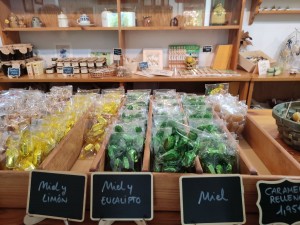
Every year many visitors come, among which it is worth mentioning the visits of many schools, where boys and girls carry out different activities, such as making candles, and understand that without bees many species of plants would disappear.
The museum has different areas in its facilities. A main building, where you will find an exhibition and shop with the full range of products that can be used from a hive, a photo gallery, handling rooms, a laboratory where quality control is carried out on each honey harvest, a classroom intended for talks, workshops, exhibitor hives with bees and much more.
Outside, you can see:

- A Modern Apiary formed by a group of mobile hives,
- An Ancient Apiary. Represented by an “osera” (bear cave) full of old hives: “trobos”, “cobos” and “cortizos” (different Galician names for “hives”),
- A traditional pantry. Type of hive in which the walls of the houses were used.
- Hexagon. Hexagonal-shaped space in which we can observe the coexistence of different swarms through glass.
- Beekeeper’s Workshop. In this building you can see different jobs that the beekeeper has to do outside the apiary: disinfection of all the material, reparations of hives, placement of wires and stamped wax on the frames.
- Garden. We can find many melliferous, medicinal, aromatic plants,… Walking through the garden you can see the important role of the bee in pollination.
A passionate conversation
At 86 years old, while removing the shell of some walnuts, he tells us his endearing story and relationship with bees. His passion that made him come home late on many occasions, and when his oldest daughter came back from school, and asked her mother about him, she replied “He’s messing with the bees”, from there “O Enredo do Abelleiro”.
His greatest dream is to add friends to his particular hive every day, and PEFC is already one of them.
What to visit?
Centro de Divulgación do Queixo e do Mel (Cheese and Honey Outreach Centre).
It is an Outreach centre about Arzúa-Ulloa Cheese and Galician Honey where the consumption and properties of these foods, their production methods and their historical evolution linked to the culture and traditions of Galician rural society are promoted.
The facilities have an interpretive museum space, a multipurpose room, a kitchen-laboratory, a store and even a beekeeping library. BAGA is the library that has been developed over forty years with publications from different countries of the world and with the Association’s own publications. This library is visited by pilgrims who make the Camino de Santiago and who in many occasions find publications in their own language.
Guided visits can be made both to the outreach centre and to the Erica Mel Cooperative, which has its headquarters in the centre itself, like AGA.
AGA, the Asociación Galega de Apicultura (Galician Beekeeping Association),has as its main purposes to promote the integral development of beekeeping in all fields, improve the beekeeping technical training of its associates and beekeepers in general, disseminate to society the advantages of the bee as a pollinating insect, ensure the quality of bee products and promote research, among others. To achieve these goals, it organizes different activities such as editing publications, organization of courses, conferences, seminars, congresses, promotion of fairs and even beekeeping trips, experiences that find more and more followers, beekeeping tourism.
Fervenza das Hortas and legends
Very close to O Enredo do Abelleiro, you can enjoy one of the most beautiful places in the area, the Fervenza das Hortas or Fervenza de Santa Marta, which has a waterfall of about 30 meters high, one of the highest falls in Galicia. La Fervenza is formed by a stream called Rigueiro de Saímes that establishes one of the natural limits between the municipalities of Arzúa and Touro, and just a few meters further down it delivers its waters to the Ulla River.
The Rigueiro de Saímes ran several mills on its steep descent towards the Ulla, fundamental elements in the agricultural and livestock development of the region. Mills, waterfalls and riverbank vegetation make up a beautiful landscape, where, as in many other cases, the forests lead to legends.
The waterfall is also known as Fervenza de Santa Marta, and its name is due to a legend. Popular history tells that a young woman who used to go to grind at the mill fell in love and became pregnant with her boyfriend, but when he heard the news, he rejected her. One night, he pushed her from the top of the waterfall with the intention of murdering her. As she fell, the young woman exclaimed: “Santa Marta me vaia!” (Santa María helps me!). Miraculously, a carballo (oak) stopped her fall, therefore miraculously saving her life.
The Role of PEFC

Attaching a mark to the PEFC label shows that forest-based products such as paper, timber, bark, resins and even food come from sustainably managed forests. This is increasingly important as consumers are well aware of the impact of their purchasing decisions and take environmental labels into account.
Through PEFC certification, we can track material from the forests, to the supply chain and to the final product you buy.


Beneficiary project of the program “O teu Xacobeo” from the Xunta de Galicia