


The stage from Portomarín to Palas de Rei, is the longest of the Camino Francés in Galician territory.
La Sierra do Careon, an area which protects the natural values, covers part of the municipality of Palas de Rei and your next stage to Melide. Moreover, Palas possess a wide artistic heritage and numerous archaeological remains, which many pilgrims decide to visit in the Castillo de Pambre (Pambre’s Castle).
It is essential to keep the degree of naturalness of those forestry areas considered natural and semi-natural, as well as to preserve the singular habitats, which motivate their conservation because of their particular ecological characteristics.
A non- intensive management is closer to natural processes tan an intensive one, however, the abandonment of an area can lead to a degradation of the forestry ecosystem and to an increase of the risks for its conservation, that is why it is so important to study and plan properly to achieve a balance.
La Sierra do Careon
It is a mountain range with a great geological interest and an exceptional botanical relevance. It belongs to the Dorsal Gallega, it is a small hill range with a stepped profile and smooth relief, whose maximum altitude is 798 m.sn.m.
There are plenty of streams from the mountains which get together in the Furelos River, final affluent of the Ulla River, and there are also wide areas with bushes. We can find a lot of common plants, but also endemic species of special protection.
Chestnut trees, oaks, pines, birch trees, ash trees, etc, together with a rich wildlife variety, such as wolves, wildboars, roe deers, partridges, hares, herons..
There are numerous hiking routes which cover the area, and even the local roads which go through the hills are of landscape interest.
The Sierrra de O Careon which covers part of the municipalities of Friol and Palas de Rei (in Lugo), and also Melide, Santiso and Toques in A Coruña, is included in Red Natura 2000 and it is a ZEPVN area.
The areas of special protection of the natural values (ZEPVN) are places which, due to their values or natural, cultural, scientific, educational or landscape interest, are necessary to protect and make sure their conservation, since they don’t count with other specific protection.
Pambre’s Castle (Castillo de Pambre)
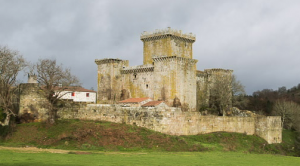
Along the Banks of the Pambre River, at the top of a hill and on a rocky area, the Castillo de Pambre is located. It was built at the end of the XIV century by Gonzalo Ozores de Ulloa, and it was considered the best sample of medieval military architecture in Galicia, since it is one of the few castles and military strongholds which are still standing after the “revolta Irmandiña” in 1467, along with the one in Monterrei (Verín) or Soutomaior.
Surrounded by a defensive wall which is about 5 metres thick and adapted to the characteristics of the ground, we can see the Castillo de Pambre. The central building is formed by a tower with square floor plan, flanked by other four towers, which are smaller and also square and they are communicated among them by a wall.
Inside the wall we can find the building with the square floor plan and the four towers in its corners. To the right of the entrance we will see the Capilla de San Pedro (San Pedro’s Chapel), which was built at the end of the XII century.
In the centre “La gran torre” or “Torre del Homenaje” is located, with three floors and 11 metres on its side. You will have amazing views from there, with green fields and trees. The first floor is blind and its interior is illuminated through small windows. In the second floor there are some remains which let you imagine an interior bridge which would communicate this floor with the wall, through a door with pointed arch and a coat of arms of the Ulloa. In the third floor there is a large window with pointed arches.
Metal structures and wooden walkways will take you along the 3 towers and different rooms.
In 2011 it was declared “ Bien de Interés Cultural” (Asset of Cultural interest ).
There is a Interpretation Centre which you will be able to visit and you will find information and films about the history of the castle. It has several exhibition rooms where you can see the role the Castles played at that time, social hierarchies and their mission.
Torrentes do Mácara
From the Castillo de Pambre you can walk a hiking route with medium difficulty, El Sendero del Pambre.
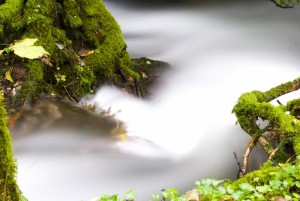
This path, which goes in parallel to the Ulla River, will take you to beautiful places, such as “los Torrentes del Mácara”, but you will be able to enjoy the landscape , flora and fauna diversity all along the way.
This section of the Ulla River, formed by fast flowing sections, waterfalls and pools, seasoned with a forest full of ash trees, birch trees and alder trees… you will find the perfect place to relax and switch off from your daily life.
Together with the noise of the water, the water havens areas and its sudden breakers , you will also find remains of old mills and you will even see the old thermal spa of Frádegas, whose sulphurous waters are well -recognised.
The confluence of the Pambre with the Ulla, waters down Mácara, are also extremely beautiful.
This is an area where people practise fishing. The Association of fishermen of Ulloa is one of the fishing associations with more members in the province of Lugo, what makes it a referent for all the initiatives which try to encourage a respectful activity with the environment and it can also get a generational replacement in the river fishing.
What to know?
Palas de Rei landscape has been a source of inspiration for writers such as Álvaro Cunqueiro or Emilia Pardo Bazán, who set the scene of its most relevant work in the Pazo de Ulloa.
Palas de Rei has an extensive artistic heritage which reflects its lordly past, fortresses, towers, castles and “pazos”, also keeping numerous archaeological remains such as “mámoas, dólmenes and castros”.
Some of these places are of special interest, like the Castillo de Pambre, Torrentes de Mácara, Iglesia de Vilar de Donas, Sierra del Careon, etc.
Iglexa de Vilar de Donas
Regarding religious architecture, we have to highlight the “Iglesia de Vilar de Donas”, one of the main referents from the Galician Romanesque, which was declared artistic -historical monument in 1931 and you can visit.
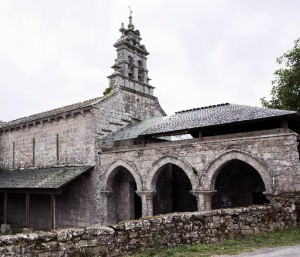
It is a construction of the middle of the XII century. Originally it was a female monastery, “donas” (women) come from there and it was donated to the Orden de Santiago in 1184. It has a Latin cross floor plan, its main nave is covered by Wood framework and it also has a rectangular transept with ribbed vault. It has three domed apses. Its wall paintings are one of the best conserved sets in Galicia.
The Role of PEFC
It is essential to maintain the degree of nature of those forest spaces considered natural and semi-natural, by establishing preventive measures to ensure their persistence, at least at the current level of conservation, and to establish mechanisms for defending valuable relics.
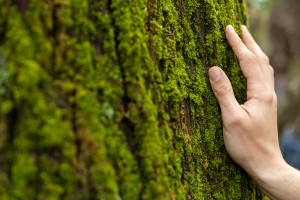
Non-intensive management is closer to natural dynamics and processes than intensive management. However, abandonment of a land area can lead to degradation of the forest ecosystem and increased risks to its conservation.
The particular ecological characteristics of certain forest biotopes (high diversity, special vulnerability, representativeness, presence of endemic, rare, protected or threatened species, genetic reserves, etc.) make habitats unique, and motivate their conservation, whether or not specific rules exist.
In the management of the forest, the maintenance of existing unique habitats should be taken into account and should be identified in the forest management document, with a cartographic record, including measures which are necessary for their conservation.


Beneficiary project of the program “O teu Xacobeo” from the Xunta de Galicia