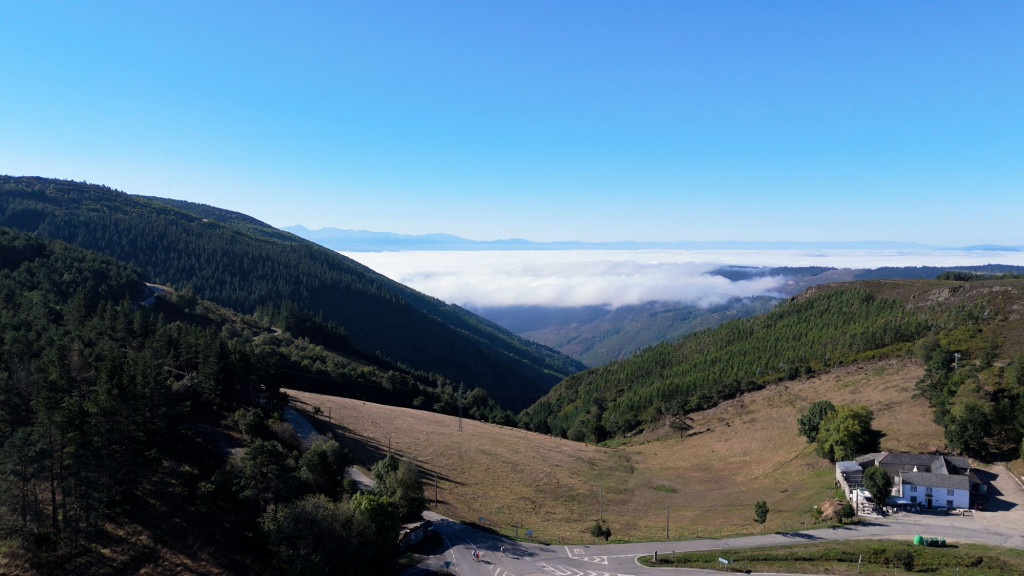
The Primitive Way enters Galicia through Alto do Acevo, a mountain pass located at an altitude of 1,030 meters. Before beginning the descent towards A Fonsagrada, it´s worth pausing to look around. From here, the landscape unfolds into one of those panoramas that invite you to slow down and observe how the mountains follow one another on the horizon and the slopes compose a landscape that is never exactly the same: it changes with the light, the fog, the rain, the seasons, and the colors of the vegetation.
What we see before us is far more than just a pretty picture. The terrain shapes the flow of water and determines the distribution of forests, grasslands, and scrubland, while also influencing the location of villages, roads, and farmlands. The diverse vegetation adds textures, volumes, and colors that transform the landscape into a living mosaic. Furthermore, place names themselves help us interpret the landscape; names such as O Acevo, Monteseiro, A Cabreira, and A Fonsagrada, among so many other locations and hills, preserve the memory of the relationship between the people and the land.
Behind that landscape lie people and communities who make decisions about the forest: what to conserve, what to utilize, how to plan operations, how to protect soil and water, and how to prevent risks. PEFC forest certification makes it possible to recognize and highlight the fact that this management is carried out in accordance with sustainability criteria.
A RECOGNIZED LANDSCAPE
A landscape can elicit an immediate response: we might find it pleasing, relaxing, or surprising, or it might make us feel small in the face of a mountain’s vastness. We do not need to know the name of every tree or understand how the terrain was formed to enjoy it.
The opportunity to contemplate, walk, breathe, disconnect, and enjoy nature also constitutes a benefit that ecosystems provide to society.
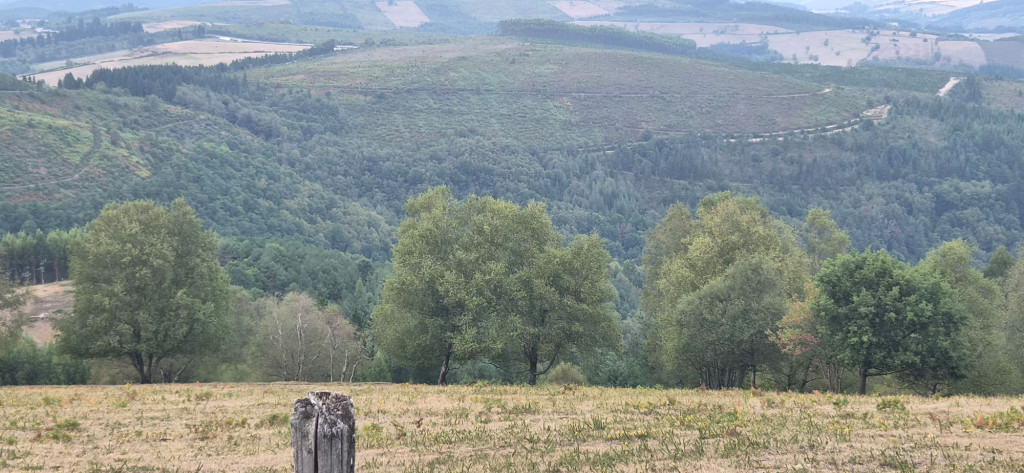
The forest can also be smelled, heard, and felt. The scent of damp vegetation after the rain, the aroma of leaves, earth, or flowers; the sound of the wind in the trees, of birds, or of water; the feeling of coolness beneath the canopy or the contrast between light and shadow, all are part of the walking experience.
These are sensations we often perceive without pausing to reflect on them, yet they contribute to our well-being and ensure that certain places remain in our memory.
Forests hold a value that cannot always be quantified, such as the opportunity to experience them firsthand. PEFC works to ensure that these intangible forest benefits are also recognized and valued.
Val do Burón, a recognized landscape
At Paradanova, the Camino offers two alternatives: continuing towards A Fonsagrada or taking the historic variant that passes through A Proba de Burón. The latter allows you to venture into the Val do Burón, recognized in the Galicia Landscape Catalogue as an Area of Special Landscape Interest.
These areas are territories where particularly outstanding natural, cultural, heritage, and visual values converge. Their recognition reminds us that a landscape is not merely what we behold; it also preserves ways of life, traditional practices, paths, and elements that explain the history of the place.
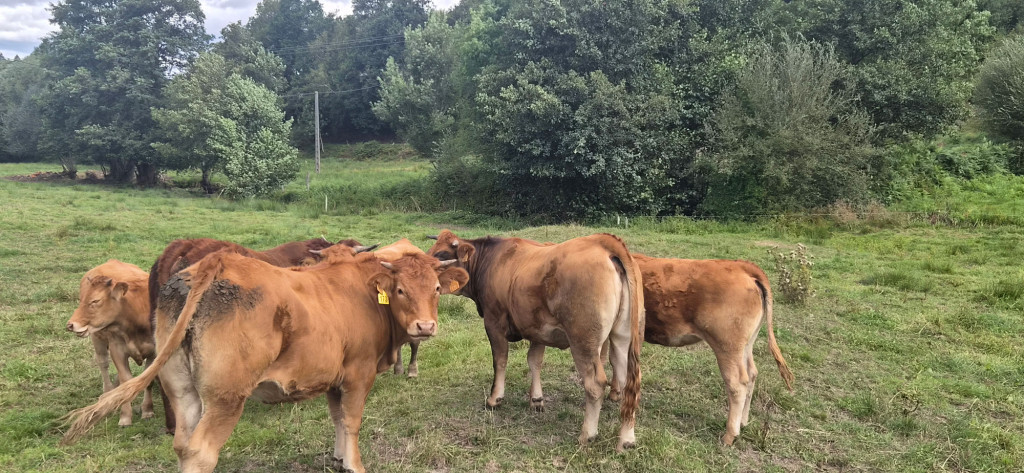
In the Val do Burón, the hillsides, watercourses, vegetation, meadows, villages, and hills form a mosaic closely linked to human presence. Every path, forest, meadow, or rural settlement is a piece of a living landscape that must preserve its values without losing the activity that sustains it.
A Fonsagrada is also part of the River Eo, Oscos, and Terras de Burón Biosphere Reserve, designated by UNESCO in 2007 and spanning territories in both Galicia and Asturias. Among the Galician municipalities crossed by the Primitive Way, A Fonsagrada and Baleira are included in this Reserve. This recognition highlights a territory where natural and cultural values are deeply intertwined with the inhabitants’ ways of life and work. Later on, upon reaching Baleira and the source of the Eo River, we will learn in greater detail what it means to be part of a Biosphere Reserve.
A Proba de Burón has a long history linked to the organization and administration of these lands. The town was likely founded around the year 1200, during the reign of Alfonso IX, and became the center of a territory consisting of approximately the present-day municipalities of A Fonsagrada and Negueira de Muñiz. A document preserved at the Monastery of Meira shows that, by 1265, the Burón council was already functioning in an organized manner.
For centuries, A Proba de Burón served as a political, administrative, and economic hub. From this location, a territory comprising hills, villages, and farmland was governed, and taxes, the obligations of the inhabitants, and the use of resources were regulated. Although its importance decreased over time, it retained its status as the municipal seat until 1835, when it was incorporated into the Municipality of A Fonsagrada.
The remains of the Tower of Burón, also known as A Fortaleza or the Tower of the Counts of Altamira, recall the era when A Proba served as a center of power. The tower was part of a larger fortress complex featuring defensive walls, multiple towers, and the quarters from which the lords administered their domains. Its history is linked to the Irmandiño revolts, uprisings that united peasants, townspeople, artisans, and members of the minor nobility against the abuses committed by great lords from their castles and fortresses.
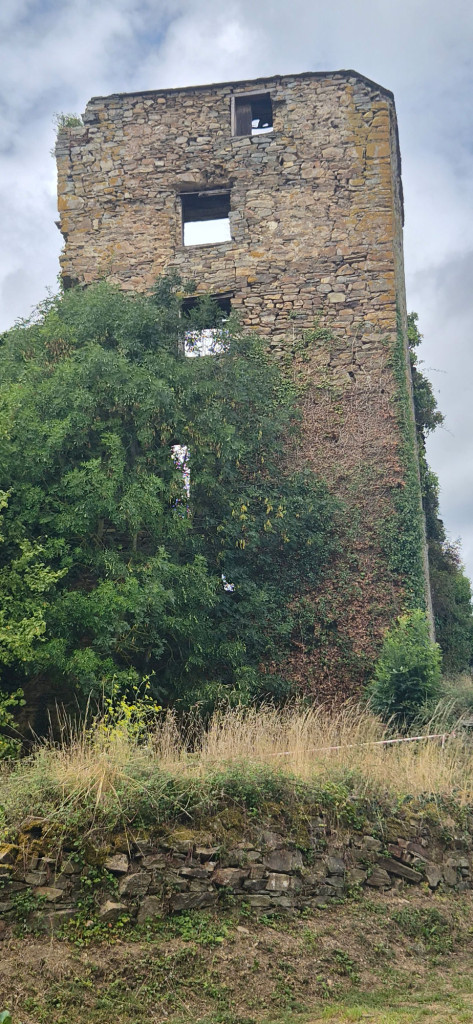
The Tower is currently privately owned and in a very fragile state of preservation; consequently, it must be viewed from the outside, without entering the premises. Its remains continue to be a landmark in the landscape, yet they also serve as a reminder of the fragility of heritage and the need to preserve elements that allow us to understand the history of the area.
The Hermitage of San José is situated in this historic setting. Its presence alongside the Tower allows one to observe how the same location transformed and acquired new meanings over time.
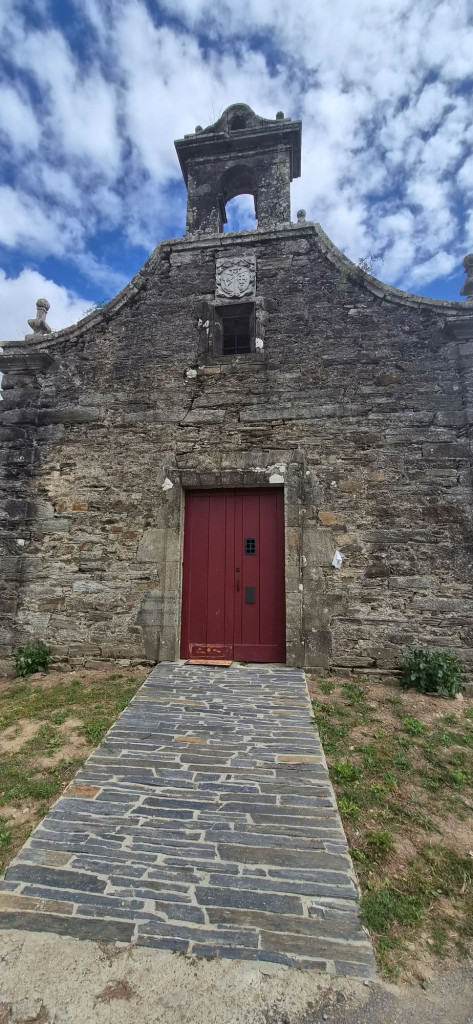
The hermitage is a simple structure featuring a stone shield on its façade. In contrast to the fortress’s defensive and manorial role, it represents the religious and communal dimension the site later acquired. Thus, the tower and the hermitage belong to different eras and served different purposes, even though they share the same landscape today.
WHO TAKES CARE OF THIS LANDSCAPE?
When we gaze at a forest landscape, we rarely think about who is behind it. Yet, many of the forests we see have owners and managers who decide how to care for them, utilize their resources, prevent risks, and maintain their environmental, social, and economic functions.
Public and private woodlands coexist in Galicia. Among the latter are community-owned woodlands, a form of private yet collective ownership characteristic of the region. They belong to the group of residents making up a community, without the allocation of individual shares, and are indivisible, inalienable, imprescriptible, and immune to seizure.
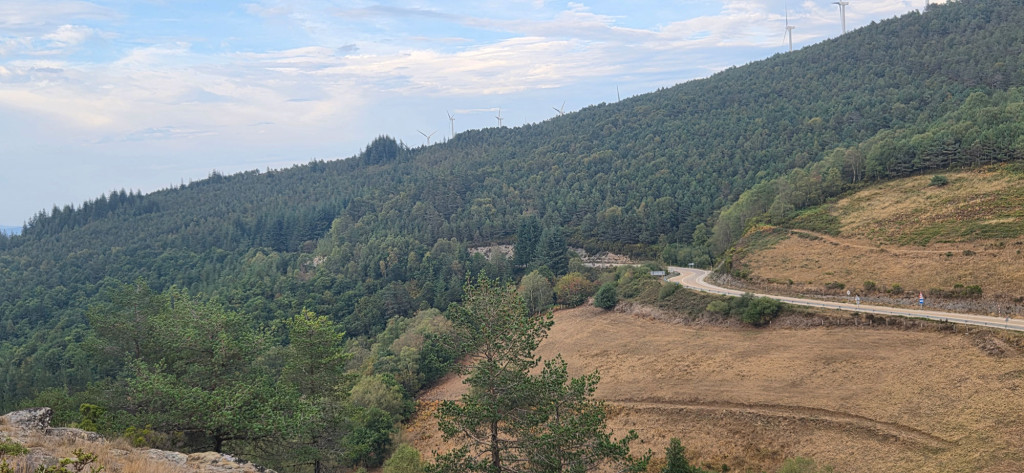
For generations, these hills provided timber, firewood, pasture, scrub, and other resources essential to village life. Today, they continue to play an important productive and economic role, while also protecting soil and water, conserving biodiversity, storing carbon, and offering places for walking and enjoying the landscape.
Its significance extends far beyond the local context: nearly one-fifth of Galician territory—approximately 650,000 hectares—consists of communally held woodlands managed by around 3,000 communities.
In the vicinity of Alto do Acevo, part of the landscape extending toward Monteseiro is linked to this form of collective ownership. The Monteseiro communal woodland comprises 1,700 hectares that have held PEFC certification since 2004, attesting—through an independent assessment—to the fact that the woodland is managed sustainably.
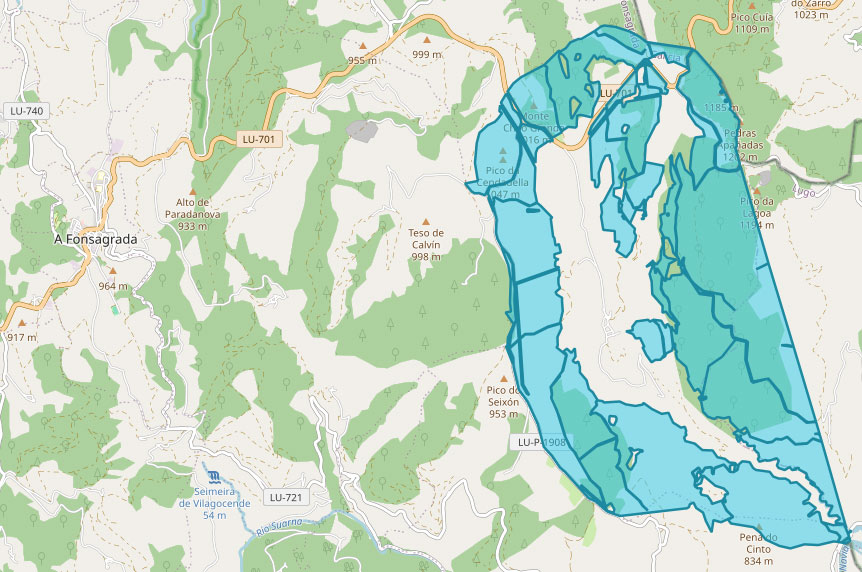
So, the next time you look at a mountain, remember that behind what you see, there are people, families, and communities making decisions about their future.
THE SEAL OF THE MOUNTAIN
Managing a forest sustainably entails far more than deciding when to plant or harvest a tree. It means planning for the long term and striking a balance between resource extraction, biodiversity conservation, soil and water protection, carbon sequestration, forest vitality, and the needs of the people connected to the land.
PEFC forest certification makes it possible to verify that forest management meets sustainability criteria. To obtain it, the forest must have an appropriate management plan in place and comply with the requirements of the Spanish Forest Certification System. An independent body reviews the documentation and verifies on-site that management is being carried out correctly.
Thanks to this process, a PEFC-certified forest allows us to recognize something not visible to the naked eye: behind the landscape lie planning, hard work, monitoring, and a commitment to its future conservation.
But the story does not end in the forest. It yields renewable resources that can be transformed into construction timber, furniture, paper, packaging, and many other products we use every day. PEFC Chain of Custody certification makes it possible to track forest materials through their processing and marketing—from the moment they leave the forest until they reach the consumer.
When we see the PEFC label on a product, we know that the forest materials used come from sustainable and controlled sources. In this way, our purchasing decisions can also help keep forests well-tended, productive, and thriving.
When you look out again from Alto do Acevo toward the mountains of A Fonsagrada, do not simply gaze at a beautiful landscape. Pause for a moment and also consider everything that landscape offers, as well as the people who work to care for it.
If you want to know which PEFC surfaces are around you, look them up at https://buscador-montes.pefc.es/
WHAT TO SEE?
Seimeira de Vilagocende
Although it lies somewhat off the route of the Primitive Way, if you stop in A Fonsagrada, it is well worth visiting the Seimeira de Vilagocende. The waters of the Porteliña River cascade through the vegetation, creating one of Galicia’s most spectacular waterfalls, with a drop of 54 meters.
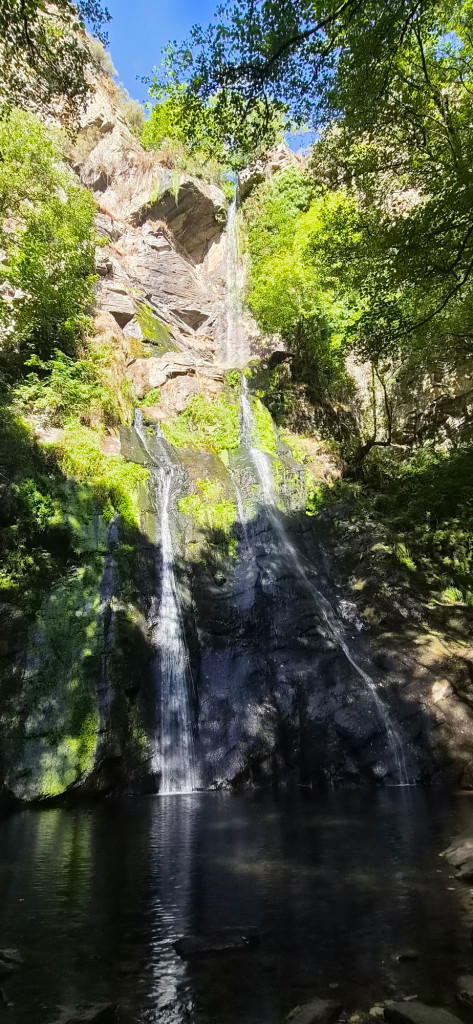
The experience begins along the access path itself. The trail descends through the trees, offering views of a landscape of hillsides, forests, and villages as you move along. The path invites you to slow your pace, observe the changing vegetation, and gradually let yourself be enveloped by the surroundings.
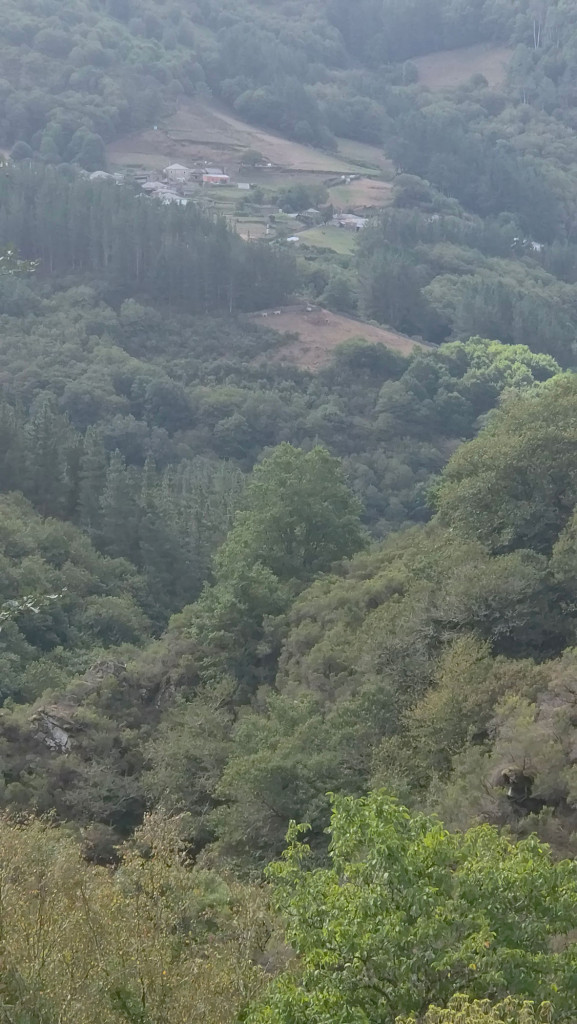
Upon arrival, the continuous sound of water dominates the setting, helping to create a sense of peace and tranquility. The shade of the trees, along with the moisture and coolness surrounding the waterfall, offer a particularly pleasant refuge during summer days. Listening to the water, breathing the fresh air, and pausing beneath the canopy are all part of an experience that goes far beyond merely gazing at a waterfall.
The Seimeira reveals how water, terrain, and forest combine to shape the landscape. The vegetation follows the water’s course, providing shade and retaining moisture, while transforming the visit into a visual and sensory experience. It is one of those places where it is worth lingering for a few minutes to listen and enjoy the moment at a leisurely pace.
The A Fonsagrada Council’s website features various routes and places of interest that allow visitors to continue exploring the municipality’s landscape and heritage.
Microlandscape Network
Some places do not need to be large to be special. Sometimes, a tree, a fountain, a small chapel, a bridge, or a stone holding a story is enough to spark our curiosity and create a sensory and emotional experience. The A Fonsagrada Microlandscape Network brings together these small spaces and hidden corners capable of conveying calm, beauty, and emotion.
The Network proposes another way to explore the area: paying attention to the details, pausing, and discovering the natural, cultural, or heritage value that may be hidden in a seemingly simple place. You can consult all the points and locate them on the mapa de micropaisajes de A Fonsagrada.
Hospital de Montouto
Among the sites included in this network is the Hospital of Montouto, situated on one of the highest and most exposed stretches of the Primitive Way. It was founded in the 14th century to provide shelter and care to pilgrims crossing these mountains, where cold, wind, snow, and isolation could turn the journey into an especially arduous experience.
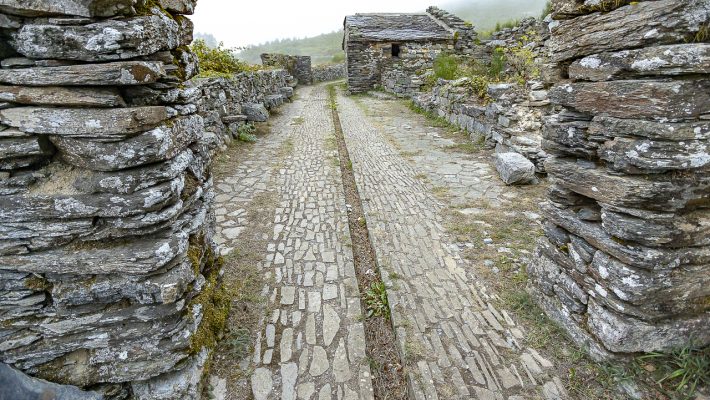
Hospital de Montouto
Imaxe da web do Concello da Fonsagrada
Its surroundings encompass landscape, historical, heritage, and spiritual values. They also offer insight into how the land and its resources were harnessed for human needs: stone and timber provided materials for construction and heating, making a place exposed to particularly harsh conditions habitable.
Dolmen of As Pedras Dereitas
Very close to the hospital lies the As Pedras Dereitas dolmen, the most visible feature of an ancient megalithic necropolis. Its massive stones speak to us of the communities that inhabited these mountains thousands of years ago and chose this site to bury and commemorate their dead.
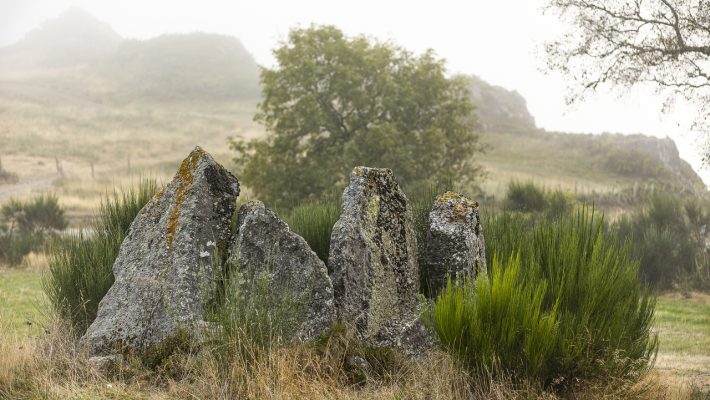
Dolmen
Imaxe da web do Concello da Fonsagrada
In this area, the landscape preserves traces of different eras. The megalithic world, the Jacobean tradition, and the history of mountain communities converge in a single space, rich in cultural, heritage, and spiritual significance.
Pedra Labrada
Near the former site of the Montouto Hospital stands the Pedra Labrada, a large upright stone generally interpreted as a menhir. Its presence reminds us that these mountains were traversed and inhabited long before the birth of the Camino de Santiago.
For centuries, stones like this one may have served as navigational markers, boundary indicators, or landmarks identifying important places. Today, they are part of the landscape’s memory, inviting us to imagine how those who crossed these lands before us related to them.
Teixos de Carballido
Two yew trees of great size and remarkable longevity—known as the teixos de Carballido—grow beside the church of Carballido. These trees have been part of the village’s life for generations and form a part of both its natural heritage and its collective memory.
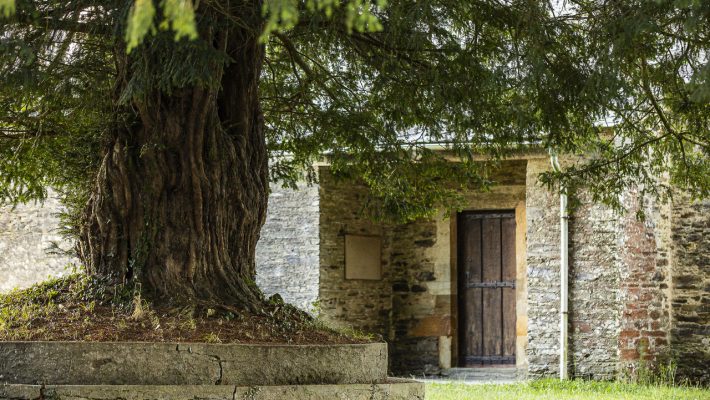
Teixos de Carballido
Imaxe da web do Concello da Fonsagrada
The yew is a species traditionally linked to sacred sites, churches, and cemeteries. Its longevity has made it a symbol of permanence and continuity. Trees like these offer shelter and food to various species, but they also preserve stories, sentiments, and meanings that cannot be measured solely by their size or age.
THE ROLE OF PEFC
The value of being mindful of what we see
The landscape we behold is also the result of decisions made regarding the forest. Conserving biodiversity, protecting soil and water, maintaining the forests’ capacity to sequester carbon, obtaining resources responsibly, and fostering the development of rural communities are functions that must coexist and be sustained over time.
Sustainable forest management seeks that balance. It is not a matter of choosing between utilization and conservation, but rather of planning each action while taking into account the forest’s various environmental, social, and economic values.
PEFC works to ensure that this responsible management can be recognized and demonstrated. Forest certification verifies—through an assessment by an independent body—that forests are managed in accordance with sustainability criteria. It also helps highlight benefits that are not always visible or easily measurable, such as the enjoyment of the landscape, the well-being derived from walking in nature, and the cultural and spiritual values associated with the forest.
In the vicinity of Alto do Acevo, the Monteseiro communal forest land holds PEFC certification, as do many other plots owned by private forest owners. Behind the landscape you see, therefore, lies a community that manages the forest and a certified commitment to its future.
Because caring for the forest also means making responsible use of its resources and keeping alive the landscape that you can behold, traverse, and experience today.