


PEFC on the way
PEFC Galicia is a non-profit association which promotes sustainable forestry management, guaranteeing they meet environmental, social, economic and ethical requirements.
The forest is part of the culture and idiosyncrasy of Galician people. 70% of our territory is forestry, so in one way or another, it plays a part in our lives, it draws our landscape, it is home to the flora and fauna, it provides with work and with a residence for rural population, it supplies food and renewable raw material, it preserves land and the water, it allows us to switch off from our everyday life and it contributes to the mitigation of climate change.
PEFC distinguishes with its hallmark all products (wood, resin, chestnuts, honey, mushrooms, biomass, textile,…), which come from certified forests, guaranteeing their traceability throughout the forest chain until the final consumer.
Thanks to the PEFC initiative in the Camino, you will understand the importance of the forests on a global and local scale. Expand your view: trees, usage, work, legends, toponymy… access each and every suggested stops, we will recommend you what to see, what to know and you will discover our forest, our industry and our way of doing things.
In the hostels you will find a book where you can describe your feelings walking the Camino through our forests, or what you will be willing to do or change in your life to achieve a more sustainable planet. The PEFC forestry certification contributes to get Sustainable Development goals, but WE NEED YOU!. Tell us about your dreams and your ideas.


1.COMPOSTELA.
Trees in the cities.
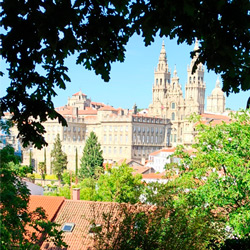
Trees play an essential role in the fight against pollution in cities. Compostela has many green spaces with various characteristics, from parks, gardens to forests which turn the Galician capital throughout the seasons.
Unique trees, special landscape areas, MANY THINGS TO BE DISCOVERED! in a city which has 52m2 of green area per inhabitant, it is above the recommendations of the World Health Organization (15m2).
The PEFC actively works to raise awareness about the importance of trees in city living.
2.VENTOSA.
Galician rural landscape.

After your way by the oak grove in Alto do Vento you will arrive at Bosque do Peregrino, a location with a wood lookout, surrounded by a small plantation of native hardwoods, which offers a panoramic view of val da Maía which allows us to understand the main characteristics of the Galician rural landscape as well as the role of the valley, the village and the parish in its configuration, historically and even today.
For PEFC, landscapes are spaces which must be considered in forest management according not only their singular, cultural or aesthetic values, but also the harmonious relationship between mankind and environment.
3.PONTE MACEIRA.
The ways.
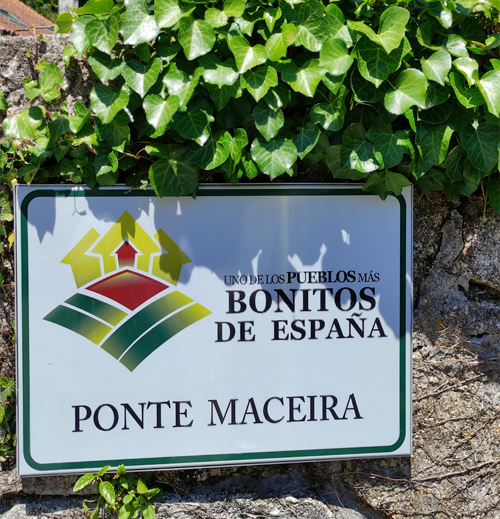
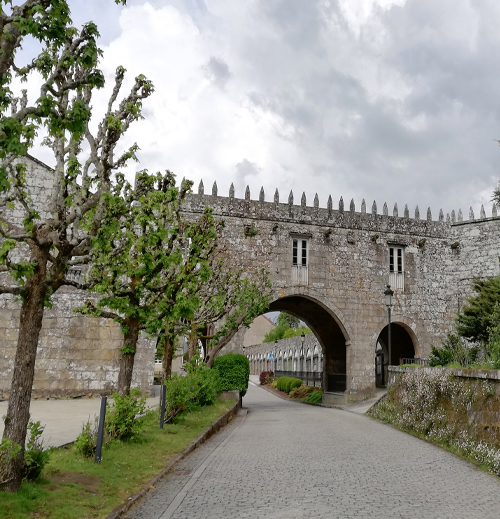
Ponte Maceira is a place not to be missed in the Way to Finisterre, documented in the historical sources. In 2020, it was recognised as one of the most beautiful villages of Spain due to his cultural and environmental values, and was listed as an Asset of Cultural Interest. Here we will talk about how the ways assembled our territory over time, by making easier the exchange of goods, ideas and values between diverse peoples and cultures. We will also talk about the surrounding trees and the linking of the ways and the forestry sector, while resting under one of them.
PEFC considers that an adequate road infrastructure is essential for the fulfilment of the management objectives, uses and protection of forests.
4.NEGREIRA.
Pazos.
Pazos are one of the most peculiar elements of Galician identity, a symbol of economic, political and social power. Departing from Pazo of Baldran in Ponte Maceira, which enjoys the shade of riverside vegetation, Finisterra´s camino passes through Logrosa next to Pazo de Albariña, and crosses the village of Negreira underneath the arches of Pazo de Coton. This is only a track of the Route of the three Pazos, if you fancy, you can continue by the river walk of Barcala´s river, and you will arrive at the Recreation Area of Covas.
Visit the viewpoint to the Miradoiro do Cotro where you can see several areas protected by Rede Natura 2000, as well as an amazing landscape.
With PEFC, forest owners know that their forest is incuded in a protected area, or affected by any other, taking it into account in their plan.
5.VILASERIO.
Uses and products of the forest.
Forest products are all around us.
Most of us are aware of the products that the forest offer us: wood for our homes and furniture, paper for books and magazines, food packaging, toilet paper, masks, even our clothes can be made from wood and we can find many products from the forest on our plate.
Did you know that the following products also contain forest materials? Painting, pneumatics, perfumes, toothbrushes, deodorant, cosmetics, detergent, clothes, medicines, corks for wine, sponges, hair dyes, etc.
In this stop, you can take a closer look about the resources provided by the forest, timber and non-timber, and the traditional Galician way of life characterized by a sustainable use of the territory based on the complementarity and multifunctionality of the different areas that make up it.
Thanks to PEFC forestry certification, we can track the products managed in a sustainable way from the forest to the final consumer.
6.CORZON.
The property of the Forest.
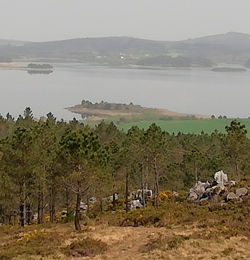
In Galicia, 97% of the forestry property is private, 64% belongs to private owners and 33% belongs to a Neighbourhood Association called “Comunidades de Montes Veciñais en Man Común”. Just 3% of the forestry property is public.
On your way to Finisterre, the council of Mazaricos is the one with more forests belonging to Neighbourhood Associations , and the Miradoiro de Corzón (Corzón lookout) is located in one of them. From this lookout you will see different tree species, activities and works carried out in the forest, and a beautiful panoramic view of “Encoro da Fervenza” (a reservoir). Several routes in this area will allow you to get to know the fauna as well as the vegetation associated to this place.
The PEFC forestry certification highlights the importance of a sustainable forestry management carried out by owners and agents.
7.OLVEIROA.
The native forest.
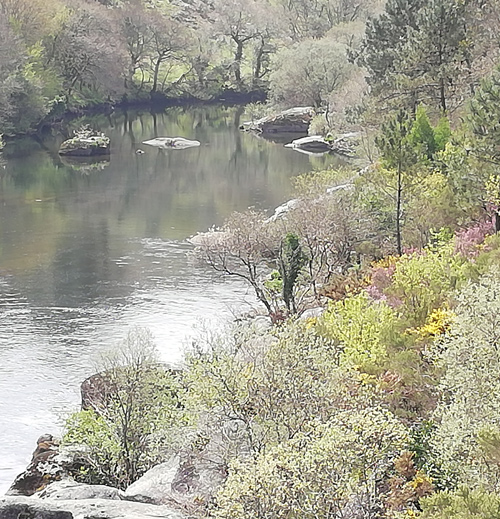
Oliveiroa is another place on the Way to Finisterre; the last stop of the pilgrim before the intersection of Hospital de Logoso, where you have to decide if you take the direct route to Finisterre or Muxía. Devesa de Anllares is located about 2 miles from Oliveiroa, next to the Xallas River. It is the westernmost native forest mass in Galicia and one of the best preserved forests in Europe, so it is worth visiting!.
Keep the natural level of natural and semi-natural forest areas, is one of the requirements for PEFC forestry certification.
8.DUMBRIA.
Legends.
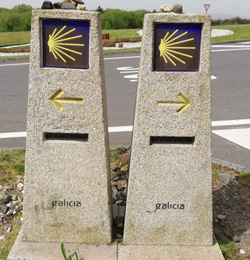
We stop here, in Fragoso river, to warn you about the danger: The vákner walks free! And this is not the only beast you should be scared of: hurry up, because the Santa Compaña goes out every night.
The forest is life sustenance, but it is also death. It can be a dark, gloomy place, where the vegetation doesn’t allow you to see anything, where the beasts roar, the wind hums and you want to escape but you are paralysed .
9.Ozon.
Horreos, Eiras de mallar.

The way to Finisterre goes through a lot of little villages which still keep their traditional character, where some buildings which have lost their original functionality but which are part of our identity. That is the case of the mills, Galician raised granaries (called ´Hórreos), “eiras de mallar” or ovens associated to bread making, which was the centre of everyday life activities in little villages, since that was the main nourishment in rural areas in Galicia. Many of these constructions and tools used in bread making were made of wood; and even the bread was originally made with the fruits of the trees.
PEFC main goal is to promote and keep the drain effect of forests stands and their wood products in the long term.
10.MILLS.
Riverwalk of Rio Negro.
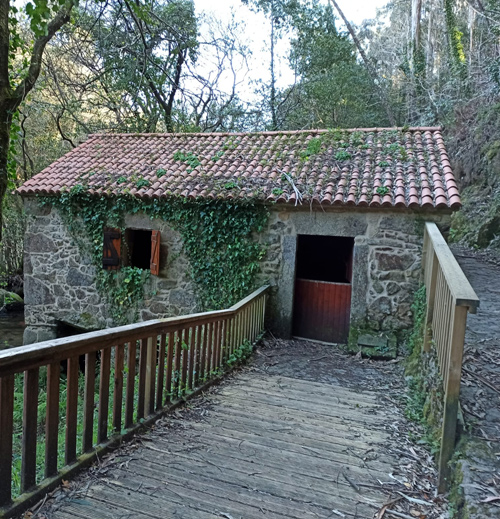
Mills are one of the most common elements of the popular architecture of Galicia. This is due to two main factors: Firstly, it is easy to generate hydropower in a country with such an extensive river network and coast line. Secondly, since mills are the essential part of the process of making bread, which was for a long time the main food of our people. You will be amazed by the riverside walk of Rio Negro.
With PEFC you will know the advantages of the ecosystem gives to society. The ecosystem services.
11.MUXIA.
Conger curing rooms.
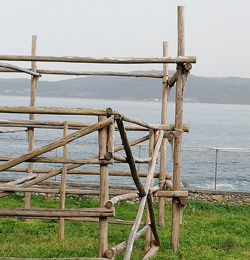
Muxía is famous for its church, Corpiño’s lookout, A Barca Sanctuary and “a Pedra de Abalar”, among others. However, we recommend you to visit some of the existing conger curing rooms too. They are an unknown heritage, but they are very valuable because of their singularity. Let’s discover why!
The forestry sector will be the factor which will help other sectors in the transition towards a new circular bio economy, offering solutions with a PEFC sustainability certification.
12.VAOSILVEIRO.
Building solutions.

The importance of the Camino determines the solution adopted to cross the watercourse. One of the simplest ways to it is the use of “poldras”. Here, in Vaosilveiro, we will dig into the building solutions and wood as a link between architecture and nature. In this area you will see a lot of wood cottages where you can stay!
PEFC certified wood is used in a lot of building projects, indoors as well as structural ones, making sure the materials used come from sustainable sources.
13.BUXAN.
Forestry industry.

Galicia is a major forest power in Europe, not only because 47% of our territory is a highly productive wooded forest area, but also has a powerful forestry industry, contributing 57% of our cut wood each year in Spain. Sawmills, board production, pulp paper, woodwork, furniture factories…, Galicia is a national leader in PEFC certified responsible companies, guaranteeing its customers the legal and sustainable origin of certified forestry products.
14.FISTERRA.
Riverbank carpentry.
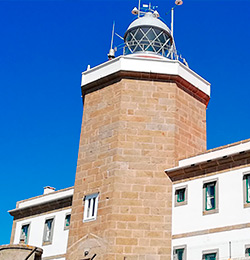
The forest also provides the raw material to build boats and fishing tools. The castle of San Carlos holds a museum about fishing and the maritime world, where you could clearly see that the coast is not just looking at the sea.
The forestry activity generates opportunities for Galician companies and forestry experts, and PEFC forestry certification contributes to its value.
15.CORCUBION.
Architecture in wood.
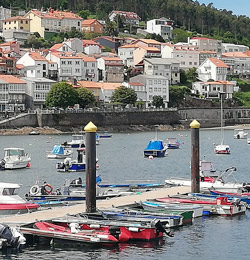
A arquitectura tradicional galega combina a pedra e a madeira como principais materias de construción. Noutros puntos da túa viaxe xa tiveches a oportunidade de coñecer algúns exemplos, como son os muíños ou os hórreos. Paseando pola vila histórica de Corcubión coñeceremos as principais características das vivendas tradicionais e o seu porqué.
When you choose forest materials with PEFC sustainable certification, you help to protect the forests of the planet!
16.CEE.
Wood commercialisation.

The growing world demand of wood and its products, make the trade of wood which is illegally used an international problem which requires global responses taking into account not only the trade regulation of this product but also the social, political and economic aspects in order to improve the rules of the wood-producing countries.
PEFC certification allows the companies in the supply chain to guarantee their customer the legal and sustainable origin of certified forestry products.
Trees.

Trees play an important role in our lives.
Trees are the main carbon sinks in the planet; they give oxygen and clean the air we breathe. They preserve soils and water, provide food and natural renewable raw material, give work, help to improve physical and mental health, give us shade and shelter on your Camino and at the same time beautify the landscape.
Would you like to know the most characteristic trees of our area?


