


PEFC on the Primitive Way
Forests, Companions on the Way
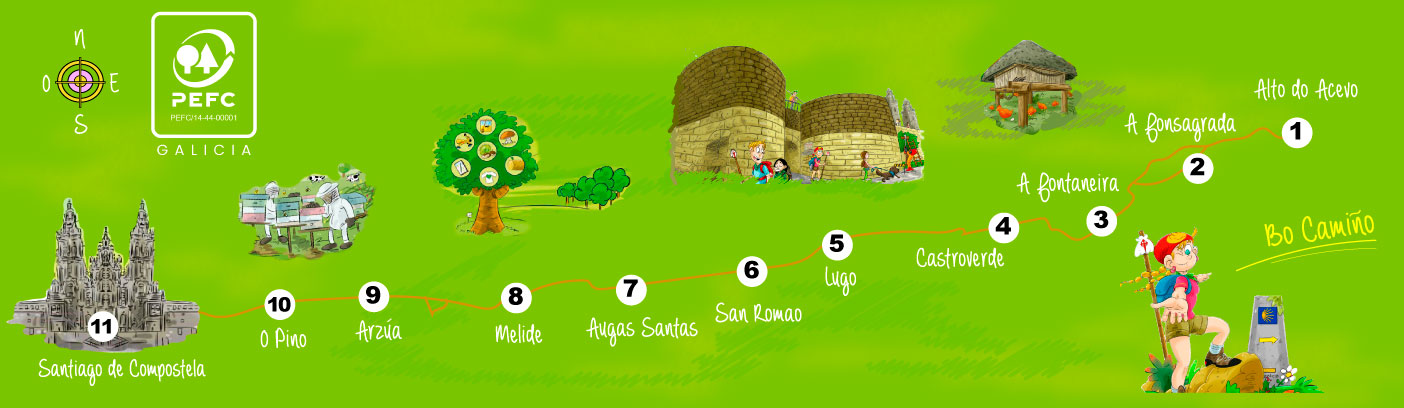
From the point where the Primitive Way enters Galicia at A Fonsagrada until it reaches Compostela, forests accompany us every step of the way, providing shade, shelter, and moments to take a break and breathe.
Silently, they capture and store carbon, regulate and protect water, maintain soil fertility and help prevent erosion, and provide refuge for extraordinary biodiversity. They are also places of rest and gathering—landscapes that hold stories, traditions, and legends, and spaces of profound cultural, heritage, and spiritual value.
All these benefits that ecosystems provide to society are known as ecosystem services. Yet behind them lie the people who care for and manage the forests, as well as the knowledge, labor, and renewable resources that are part of our daily lives.
Along the Primitive Way, you will discover some of these connections and learn how sustainable forest management and PEFC certification help keep forests alive, productive, and capable of continuing to provide us with all these benefits in the future.
1.ALTO DO ACEVO.
A landscape to look at, feel and discover
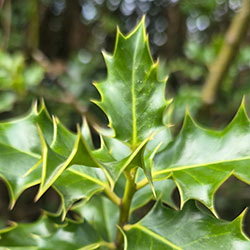
The Primitive Way enters Galicia through Alto do Acevo, a mountain pass located at an altitude of 1,030 meters. Before beginning the descent towards A Fonsagrada, it´s worth pausing to look around. From here, the landscape unfolds into one of those panoramas that invite you to slow down and observe how the mountains follow one another on the horizon and the slopes compose a landscape that is never exactly the same: it changes with the light, the fog, the rain, the seasons, and the colors of the vegetation.
What we see before us is far more than just a pretty picture. The terrain shapes the flow of water and determines the distribution of forests, grasslands, and scrubland, while also influencing the location of villages, roads, and farmlands. The diverse vegetation adds textures, volumes, and colors that transform the landscape into a living mosaic. Furthermore, place names themselves help us interpret the landscape; names such as O Acevo, Monteseiro, A Cabreira, and A Fonsagrada, among so many other locations and hills, preserve the memory of the relationship between the people and the land.
Behind that landscape lie people and communities who make decisions about the forest: what to conserve, what to utilize, how to plan operations, how to protect soil and water, and how to prevent risks. PEFC forest certification makes it possible to recognize and highlight the fact that this management is carried out in accordance with sustainability criteria.
2. A FONSAGRADA.
Wood: a resource for building the future
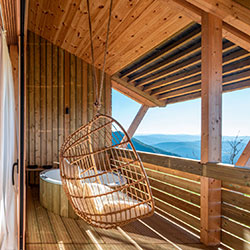
As we make our way from Fonfría toward A Fonsagrada, the structures we encounter reveal another significant relationship between the forest and society: the use of wood to create spaces for living, working, storing food, or finding shelter.
For generations, mountain communities built using the resources available to them. Stone, slate, wood, and plant fibers were combined to suit the climate, agricultural activities, and the needs of each family. Today, innovation and new technologies allow wood to remain a part of our architecture, from the restoration of historic buildings to the construction of homes and multi-story buildings.
Wood is a natural, renewable material that connects the forest with the places we inhabit. When it comes from sustainably managed, PEFC-certified forests, we can trace its origin and utilize this resource with confidence as we continue to build the future.
3. A FONTANEIRA.
Where the water rises
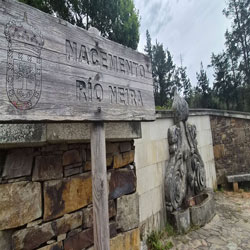
In these mountains, water begins journeys that will eventually connect places far apart. The Neira River rises near A Fontaneira, carrying its waters to the Miño; further north, in Fonteo, the first waters of the Eo spring forth, crossing mountains, forests, and valleys before reaching the Cantabrian Sea.
The water we see welling up from a spring or flowing through a river or stream is part of a long journey that begins with rain, fog, or snow. Forests play a role in this process: they cushion the impact of precipitation, facilitate infiltration, protect the soil against erosion, and help maintain riverbanks and water quality
Caring for forests also means caring for the water we drink.
These essential benefits are part of the ecosystem services that forests provide to society as a whole. PEFC works to ensure they are recognized and valued.
4. CASTROVERDE.
A forest that gives life
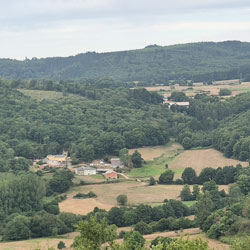
After crossing the Alto da Vacariza and heading towards Castroverde, the Primitive Way leaves the highest mountains behind and enters a landscape of gentler contours. Meadows, farmland, villages, and wooded areas follow one another in a region where the hills are an integral part of daily life.
In these woodlands, trees that have stood alongside local communities for generations coexist with forest areas managed for the production of timber and other resources. Some are notable for their age, their connection to a specific place, or the stories they hold; others are grown to be harvested and transformed into housing, furniture, paper, packaging, and the many products we use every day. All of them can be part of a living, diverse landscape that is constantly evolving.
A vibrant rural area needs people who work and find opportunities there. Responsibly utilizing forest resources generates activity, sustains local businesses and jobs, and helps maintain the bond between landowners, communities, and their land. Because when the forest holds value for those living nearby, there are greater reasons to care for and manage it, and to keep the landscape alive.
5. LUGO.
From the mountains to the city
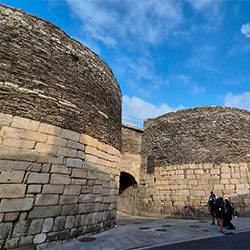
After traversing mountains, hills, and small villages, arriving in Lugo transforms the landscape of the Primitive Way. City streets, buildings, and urban bustle appear, yet nature does not vanish; it remains present in the rivers, parks, trees, and green spaces that run through and surround the urban environment.
The forest also enters the city in less obvious ways. It is found in the wood of a piece of furniture or a musical instrument, in the fibers of a basket, in the pages of a book, and in numerous products we use every day. Behind them lie natural resources, but also knowledge, planning, craftsmanship, and the people capable of transforming raw materials into useful, durable objects imbued with culture.
Lugo allows you to discover all these connections. The Way winds through a city built upon its history, integrated into a Biosphere Reserve and linked to the mountains through science, craftsmanship, culture, and our own choices. The landscape changes, but the relationship with the forests endures.
6. SAN ROMAO DA RETORTA.
Paths of Memory
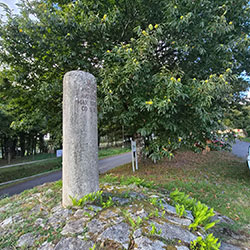
We leave Lugo behind, crossing the Miño River via the Ponte Vella—a bridge of Roman origin. Gradually, city streets give way to hamlets, fields, and hills, as the Way leads us through a landscape where every era has left its mark.
Over the centuries, people blazed trails, harnessed natural resources, and organized the landscape, leaving behind small and large traces of their history. Some are easily recognized; others go unnoticed, hidden amidst the vegetation or woven into the daily life of the villages.
Along this stretch, PEFC invites you to discover those traces and view the forest from a different perspective: as a space that offers us resources, preserves our heritage, and requires responsible management to remain part of our future.
7.AUGAS SANTAS.
The forest that does us good
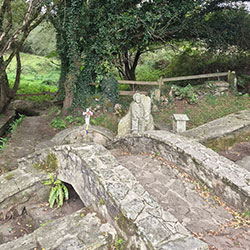
Some names spark curiosity and invite us to uncover the stories they hold. Augas Santas is one such name. In this parish within Palas de Rei, the Fountain of San Xurxo serves as a starting point for exploring a connection that has always been with us: the relationship between nature and our health.
The water we drink, the plants that contributed to the development of medicines, the natural materials that surround us and the paths along which we walk are all examples of how the mountain environment is present in our well-being. Some of these benefits have been known since ancient times, while others are currently being studied by science, which helps us better understand their importance.
Here, PEFC invites you to discover how forests can contribute to our physical and emotional well-being, and why their sustainable management is also a way of caring for peopl
8. MELIDE.
The trees of the Camino

In Melide we join Caminos. The mountains of O Careón form the last section of the Camino Primitivo before joining the Camino Francés in the centre of Melide.
While you enter into the municipality of Melide, you start your route in the province of A Coruña and your landscape also varies. It is a transition stage in terms of tree formations.
The municipality has a high agricultural activity, and of course tourism, linked to the Camino de Santiago, although the forestry sector is becoming more importance.
Maintaining or increasing the forest area, especially the wooded area, except for forest defense actions (fires), adaptations to current legislation or others aimed at improving its multifunctionality, is one of PEFC’s objectives. It is essential that this area is orderly, which will allow forest owners and managers to properly plan and schedule the work to be carried out on their forests.
9. ARZÚA.
The forests, more than just wood

The traditional Galician way of living has been characterized by a sustainable use of the territory based on the complementarity and multifunctionality of the different spaces that integrate.
Although on many occasions we do not notice it, we are surrounded by forest products. At this stop you will be able to deep into the resources provided by forests, timber and non-timber.
From the mountains, we can obtain wood to build houses, make furniture, paper for books and magazines, food containers, toilet paper and even our clothes can be made with wood fibers, but they also offer us many other resources such as medicinal plants, resin or foods such as chestnuts, walnuts, mushrooms, blackberries…
Through PEFC forest certification, we can trace sustainably managed products from the mountains to the final consumer.
10. O PINO.
Illustrious of O PINO

O Pino is practically in the centre of Galicia, with a gentle relief, bathed on its northern slope by the Tambre River, and on the southern slope the streams direct their waters towards the Ulla basin, drawing beautiful landscapes accompanied along its course of mills, recreational areas, river beaches or hiking trails.
The forest area occupies more than half of this municipality. The forest is an essential part of the Galician economy, with a mostly rural population and where most of the forest exploited and first transformation companies are located, working in the mountains of the area and generating local employment.
Innovation and technological improvement contribute to the opening of new markets, and the forestry sector has the opportunity to be the protagonist and facilitate a circular bio economy.
Galicia is a national leader in PEFC certified responsible companies, guaranteeing its clients the legal and sustainable origin of certified forest products. Many of the forestry companies in O Pino have the PEFC Chain of Custody certification.
11.COMPOSTELA.
Trees in the cities
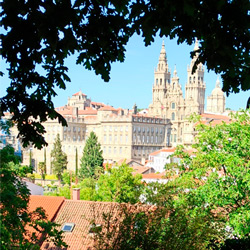
Trees play an essential role in the fight against pollution in cities. Compostela has many green spaces with various characteristics, from parks, gardens to forests which turn the Galician capital throughout the seasons.
Unique trees, special landscape areas, MANY THINGS TO BE DISCOVERED! in a city which has 52m2 of green area per inhabitant, it is above the recommendations of the World Health Organization (15m2).
The PEFC actively works to raise awareness about the importance of trees in city living.

Project promoted by the Xunta de Galicia under the “O Teu Xacobeo” program